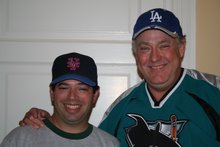
Let me hand it to Ed for holding the site together while I was off in la-la land. Wasn’t that a great article on Tim Lincecum? Lucky Ed got to meet the Freak!
As for me, you could probably tell from my last post that I was kind of fed up with my teams. Therefore, I stayed away from blogging for a bit, because I didn’t have anything positive to say, and I really didn’t want to drown myself in all that negativity. Hearing the latest about Tiger Woods did little to restore my faith.
Now I’m back, but it’s not to be positive. After having experienced the Giants football game—and the end of their once-promising season—yesterday, I am so filled with frustration that I have to let it all out here.
How could any team with so much on the line—postseason play, the closing of Giants Stadium—just completely not show up? It is inexplicable to me. The Giants had to win to stay in contention for a playoff berth. Even though Dallas and Green Bay both won, keeping them ahead of Big Blue for the week, I wouldn’t be so sure that they will both win next week. The Packers play Arizona, and the Cowboys play Philadelphia—don’t be surprised if the Iggles whip the ’Boys to prove that they deserve the division crown.
The Giants were a disgrace, and I woke up this morning embarrassed to be a fan of theirs. I’m sure this will pass at the end of the season, but for now? Phooey! There are not enough words to describe just how bad the Jints were, but to give you a hint: they were booed off the field at halftime by their own fans in the last game to ever be played at Giants Stadium. And this was in front of the many Giants greats who showed up for the stadium’s closing!
I know a lot of people want to blame someone—I do, too. So here’s who I think is to blame.
First, let me say unequivocally that I don’t blame Eli Manning. Was he great this year? No, but his numbers were the best of his career, and I think he is showing that he is a pretty darned good QB and still improving. I know a lot of people say he’s awful, but along with his ring, he has a Super Bowl MVP, so we are not exactly talking Trent Dilfer here. Also, it’s hard to blame the offense when the defense can’t get off the field. But we’ll come to the defense in a minute.
The receiving corps, which everyone said would be weakness this year without Plaxico Burress, has actually been a great strength. Steve Smith has broken a couple of Giants receiving records, and rookie Hakeem Nicks looks like the real deal. Mario Manningham is fine, but he could have better hands. Nevertheless, all told, the Giants receivers have been pretty good, as well.
The only aspect of the offense that needs a lot of work is the running game. Not only does this mean that perhaps Ahmad Bradshaw should be the feature back next year (Brandon Jacobs only had one—yes, one—yard on six carries yesterday), but maybe the offensive line could use a tune-up. I like the O-line, but those guys sure didn’t do much for the run. Granted, they had a few injuries, but still…
I will briefly touch on special teams by saying that maybe it’s time for Jeff Feagles to retire. He has been a fantastic asset to the Giants over his career with them, but in 2009, he had some really bad punting games, and the Giants D has been unable to stop anyone on a short field this season.
Ah, the Giants defense. “What defense?” you might ask, and rightfully so, because it is one of the worst defenses in the NFL this year. In one statistic that says it all, the Giants are last in preventing a touchdown when the opponent is inside the red zone. Wellington Mara would surely roll over in his grave if he could have observed the defense the past few months.
Now defense is supposed to be a Giants hallmark. Any team that won anything for Big Blue was always built around defense. So it is really inexcusable for the D to have been so very bad—and it was bad on all three levels. The defensive line didn’t have a pass rush and couldn’t stop the run—except against the hapless Redskins. The linebackers were fair to middling, and I don’t want to hear that it was because Antonio Pierce was injured. The backers were only average even while A.P. was healthy.
The Giants secondary deserves a paragraph all its own. But what can I say except that it stank? Yes, there were injuries there, too, but every team has injuries. They do not explain why the defensive backs failed to make an appearance against Carolina yesterday—or against anyone else earlier in the season. The obvious one to point fingers at for the defensive failures is rookie defensive coordinator Bill Sheridan. Despite the fact that I think he should go, he probably deserves one more chance—albeit on a tight leash.
As for Tom Coughlin, it speaks volumes that he let the players know how important the game was and they still laid an egg. Are the players starting to tune out Coughlin? Well, the man won a Super Bowl and had the G-men in the playoffs the last four years in a row. He probably deserves to stay one more year, too, as long as things get turned around.
I saw a comment today by a Carolina fan after an article about the game—amidst all the crying and moaning by Giants fans, the Panthers fan said something about perhaps giving Carolina credit because they played a great game. But no matter how great the Panthers played, the Giants had so much more riding on the outcome. If Big Blue had shown up yesterday the way they showed up the previous week against Washington, it wouldn’t have mattered how the Panthers played. The Giants would have won.
Instead, they get to play Minnesota in a meaningless game for them and then go home until Fall 2010. It sure would be ironic if the defense came to play next week, when it doesn’t matter anymore. They might as well not show up, since it seems like most of them started their offseason with two weeks to go anyway.
I expect Dallas fans to laugh it up, but there’s no way they’ll win it all, and the Cowboys will be lucky to even win a playoff game, which they haven’t done since 1996. The Giants have won a Super Bowl a lot more recently than that! As for the Eagles, they sure looked good this year, but I doubt they’ll take it all, either, against the real powerhouses like the Colts and Patriots, or even the Saints and Vikings. So good luck to the Giants’ division rivals—give me a call when you actually win something.
Monday, December 28, 2009

Wednesday, December 23, 2009
Happy Holidaze from Ed & Meat on the Street!

 It was a fun and interesting sports year in 2009. What will happen in 2010? Will Tiger get back on the course or the broads? Will the Yankees buy an entirely new team for '10? Will I meet The Freak again and will he win another Cy Young? Will the Mets ever land a quality free agent again? Will California divorces kill both the Dodgers and the Padres? And can the Colts go door-to-door and win the Super Bowl undefeated? Can the Lakers repeat? Will the San Jose Sharks finally get to a Cups Final? Will the Rams, Lions and Browns improve next season? And maybe, most importantly, will there be another excited year of great games and emerging stars?
..........stay tuned! And thanks for being a reader of Ed & Meat on the Street!
Saturday, December 5, 2009
I Meet The Freak
 As a rule, I don’t like to bother celebrities when I see them in public, but every once in a while I’ll run into someone and I can’t resist. I’ll always approach them very respectfully, asking them like royalty if it’s okay to spend a moment with them and usually it’s a 50/50 proposition.
I’ve encountered some athletes in the past who were less than a pleasure to meet. Barry Bonds was considerably less than nice, to say the least, and other people like golfer Greg Norman, sports announcer Jim Rome, HOF pitcher Goose Gossage and of course, Willie Mays (who I tried to interview in 1999) were legendarily rude and fulfilled stereotypes about pro athletes acting boorish.
But, when I ran into double-Cy Young award winner San Francisco Giants pitcher Tim Lincecum the other day at a Starbucks in the Fillmore of The City, it was a thrill and a refreshing chance encounter with a smart, engaging individual pausing to talk to an avid fan. (Even though I am Dodgers die hard for 40 years).
I approached Lincecum and told him that I was pro-420 and he instantly replied in muted tones. But what he said was off the record, so I can’t say anything more. (If you didn’t already know, he got busted for having a small amount of marijuana a few weeks back.)
While I was chatting up The Freak (one of Lincecum’s nicknames) and bombarding him with questions in rapid succession, I just got the feeling that Tim plays baseball just like he’d ride his skateboard or bicycle. Here I was, a supposed grown man drooling to talk to him and the impression he gave me was “it’s no big deal.” I even sensed a little sympathy from him for a middle-aged guy enthralled by a kid who can throw in high 90’s and make all-star hitters look like little leaguers.
My overall impression is that Lincecum sees himself as basically someone who just got really good at throwing a ball, but somebody who’s not even 100% onboard with the lore and wow surrounding major league baseball. When a 51-year-old male walks up to Tim and starts treating him like the Pope, Lincecum is amused, but no longer surprised anymore. Two Cy Youngs will do that.
I asked him if he gets noticed in public more all the time, especially now after the two
Cy Youngs. “It’s so random. I’ll be at places where I’d think I’d be noticed and no one knows who I am. Other times I’ll be walking down the street and people will come out of their homes to talk to me, which is strange. But, it’s all cool.”
In one word, Tim is just cool. Wearing a wrinkled t-shirt, flip flops and shorts, sending texts on his iPhone and drinking one of those caramel, whip cream covered coffee things. (I call those concoctions “dessert camouflaged as coffee.”)
I did tell The Franchise (another one of his nicknames) that he only has to win three more Cy Youngs in a row to set the record. “Greg Maddux and Randy Johnson won it four times in a row,” I said. “So that’s the benchmark, I guess.” “Cool,” Lincecum offered.
Then I decided to show off and run some other baseball factoids by him. “Koufax, Palmer, Pedro Martinez and Roger Clemens have all also won the Cy Young back-to-back like you,” I offered. “Nice,” he said. (Later I looked it up and I was correct, although I did miss Denny McClain, who won it in 1968 and again in 1969, a co-owner with Mike Cuellar from Baltimore—the only time there have been two co-winners.)
In summary, Lincecum was so open and forthcoming that is was a breath of fresh air. I sure hope he keeps that great attitude over the years, but it might be tough if he wins a couple more Cy Young awards.
In the end, I gave Tim (we’re on a first-name basis all ready) an official baseball hat from www.thisgreatgame.com. He didn’t don the cap when I presented it to him, probably because he didn’t want to mess up the do, but hopefully in the future I’ll see him wearing that hat out in public. He’s that type of kid.
Tuesday, November 17, 2009
My Interview with Bob Locker

 Bob Locker pitched in the pros from 1965 to 1975 for the Chicago White Sox, Seattle Pilots/Milwaukee Brewers, Oakland Athletics and Chicago Cubs. At age 27, Locker made his debut for the Chisox, tossing two innings and giving up three runs. He settled down and made 10 appearances that season following that initial appearance and ended his rookie year with a respectable 3.15 ERA. In 1969, Locker was traded to the expansion Seattle Pilots, posting a 2.18 ERA for a team that finished last in the division. In 1970, Locker’s contract was purchased by the Oakland A’s. In 1972, he was a key member of the World Series champs, when he posted a 6-1 record with a 2.65 ERA. Locker frequently came into in the seventh or eighth inning to setup closer Rollie Fingers. Locker appeared in the AL Championship that year, giving up two runs in three innings. On October 21, Locker made his first and only appearance in the World Series, relieving Vida Blue in the sixth game of Game Six. He gave up a single to Tony Perez but got the final out of the inning. A month later, Locker was traded to the Chicago Cubs for outfielder Billy North. Locker concluded his career with the Cubs, sitting out the 1974 season to undergo surgery to remove chips from his pitching elbow. In 1975, Locker made 22 appearances and posted an ERA near 5.00, thereby ending his baseball career. Locker and his wife currently live in Lafayette, California and he spends much of his free time fishing and hunting. He’s a graduate of Iowa State University and a member of the school’s Hall of Fame.
The Seattle Pilots: “I was traded from the White Sox to the Pilots for Gary Bell in June, 1969. Seattle certainly wasn’t the end of my career, but I spent a lot of time in Chicago trying to find my out pitch and I guess they got tired of waiting. The White Sox traded me after a couple of weeks pitching poorly, which turned out to be a mistake, because 2-3 bad weeks isn’t an entire career and they should have been more patient with me, in my opinion. I was upset and didn’t want to go to Seattle, but they don’t give you much of a choice—they trade you and you go. In Seattle, I found my out pitch, my sinker, and as a result I had a 2.18 ERA and gave up only eight runs in 30 appearances for the Pilots. Seattle lacked one thing--talent. It was a group containing many different personalities, let’s put it that way. Joe Schultz was the manager for the Pilots, and he was not a baseball strategist, but he was a very good manager because he knew his job, which was to get 24 guys on the same page. And with a bunch of players picked up from here and there, we were in third place going into the final one or two months of the season. I think we looked up at one point and said what are we doing here? So, we didn’t play to our capabilities after that. We had some real offbeat folks up there in Seattle, so I fit right in. Mike Marshal was a genius, especially about pitching, but he was basically a loner. Jim Bouton was scribbling stuff down in this notebook all the time, but I never thought twice about it. (Bouton wrote Ball Four, considered to be the best baseball book ever written.) He caught a lot of heat about it when his book came out and I heard Mickey Mantle never spoke to Bouton again. People felt like Bouton gave away inside secrets, but all he really wrote about was what actually happened. There was a lot of that type of behavior--chasing skirts and drinking to excess, simple rough housing most of the time--but I stayed clear of all that mischief. I’d rather fish or hunt than sit in a bar or in a nightclub any day.”
A Young Manager in His Formative Years: “Tony LaRussa sat on the bench with the A’s in the ‘70’s when we were playing together in Oakland and he absorbed all the information about the game that he could. The best managers are either catchers or guys who really aren’t talented but can figure out how to make the best of their situation, and Tony was one of those guys. He’s the best manager in baseball right now, because he’s the guy who understands the game well enough off--handling pitchers, utilizing each player’s best abilities and manipulating the mental side of the game to his team’s advantage.”
Charlie Finley: “Finley was a real character and a lot of people, maybe most of them, didn’t care for the man. But, I respected him because he did what he believed in and stood by it while everyone else called him a crazy coot and a bunch of other things I can’t repeat. Many of his players didn’t like Charlie or trusted him, but at least they recognized that he would do whatever he could to put a winning team on the field. Those A’s teams in the early ‘70’s are some of the best ever.”
Catfish Hunter: “An all-around prince—a real classy fellow. Everything you’d want on your team. Great pitcher, fielder, pretty decent hitter for a pitcher; he never said a bad word about anyone; a consummate competitor; the great competitor, and a great fisher and hunter—so he was my favorite guy on that team. When he got sick later in life, it was just terrible.”
Vida Blue’s Rookie Season: “1971 was his phenomenal year and I remember it very vividly. It was probably the most awesome performance by any pitcher I’ve ever seen. To watch what he was throwing up there was amazing. There are certain secrets to pitching—they’re guys who throw to the corners like Catfish did; guys like Drysdale or Ryan who can ride the ball and defy the rules of gravity or throw a curveball that falls off the table. But, Vida’s fastball was so unique; with it running in all four different directions. It would go anywhere except right out over the plate. It was a pleasure to watch. Vida attracted huge crowds on the road and there was a buzz throughout the stadium every time he pitched.”
Dick Williams: “Dick was the best manager I ever had, but I don’t think he liked me. If you asked him, he would say something not too kind about me, I imagine. I was a free spirit, or whatever you’d call it and Dick just didn’t dig my vibe. But, I respected him more than any manager I ever saw. He called me an “odd ball” and stuff like that. I pitched well for him in 1972 (6-1, 2.65 ERA) and he wouldn’t pitch me in the World Series except on a limited basis, but I can understand that. He had Vida Blue in the pen that Series and he used him in almost every one of those games, and his starters played well, so it just worked out that way--that was fine. It wasn’t personal. I was basically a setup guy for Rollie Fingers, who was a pretty decent closer (laughs.)But Williams wasn’t enamored with me, I imagine, because they traded me to the Chicago Cubs for Billy North one month later.”
Saturday, November 7, 2009
The Wisdom of Wally Westlake


Wally Westlake was a utility player who had a 10-year career from 1947 to 1956. He played for the Pittsburgh Pirates, St. Louis Cardinals, Cincinnati Reds and Philadelphia Phillies all of the National League and the Cleveland Indians and Baltimore Orioles both of the American League. He played third base and outfield. He was elected to the National League All-Star team in 1951.
Westlake is a graduate of Christian Brothers High School (Sacramento, California.) He currently lives in Sacramento.
No Quitters Apply: “There were quite a few pitfalls in my baseball career before I made it to the major leagues. I was originally signed by the Brooklyn Dodgers at age 19 in 1940. They sent me to Dayton, Ohio, Mid-Atlantic League, Class D. They were paying me around $120 a month, and my first thought was, what on earth am I going to do with all that money? Well, I didn’t play well. Every curve ball fell off the table and I was a day late on every fastball, so it was not a real confidence builder, to be certain. They called me into the office one day, and gave me a pink slip and my bus ticket home. They told me I should go home, forget about baseball, because I’d never have the skills to be a professional ballplayer. So, that night I’m leaving for the bus, and on the way there, I swing by the ballpark; the lights are on and the game is on. Forgive me, but the tears and the snot was flowing and I asked myself right there--you think I am going to quit? Not yet. The worst thing that scared me was the idea of facing my dad. I couldn’t face him as a failure. Fear of failure is one of the greatest motivators in the world, believe me. So, they let me stay and pretty quick I started playing better. And before I knew it, I was moving up through the minors at a pretty good clip.”
Casey Took a Swing at Helping Wally: “I had some great teachers along the way, like Casey Stengel during my career in the minor leagues. He was a very strong force in my career starting in 1946. He saved my butt. Called for me one day early in the season and said, “You got talent and you can catch and run well enough to play centerfield, but there’s a lot more to it than just that. I am going to teach you how to play at the major league level.” And he did. For six months, he rode my biscuit, let me tell you. “Mister, you got your head where the sun don’t shine,” he told me. He was tough, but he made the game fun. He taught me how to read the pitchers, how to anticipate in the field, so that I was in position to make the tricky catches. He turned it around for me. I was 25 years old at that point and I was running out of time. Today, if you’re 25 and still in the minors, they give up on you. So, every chance I get, I’m proud to say thank you to Charles Dillon Stengel.”
His peculiar place in history: “It turns out that I’m the first white player who ever got hit by a pitch from a black player. It was a kid named Bankhead, a rookie pitching in middle relief for the Brooklyn Dodgers, making his debut and pitching in front of a packed house at Ebbets Field in late August, 1947. He was the first black pitcher to play in the majors. Everyone kind of hesitated when he hit me, there was almost like a hush. It was like what’s gonna happen next? But nothing happened and the game went on. It didn’t matter to me one way or another. I didn’t care if he was blue, green or purple out there on the mound, because he’s trying to get me out and I’m trying to whack his butt, regardless of who he is. But, my name gets mentioned quite a bit with that piece of fairly meaningless baseball history.”
Jackie Robinson: “I look back at all the crap Jackie went through that first season and I have nothing but utmost respect for the man. They did some unspeakable things to Robinson, and he should have kicked some asses, which he was more than capable of doing. A real man has to turn his other cheek, but your average individual would have blown his temper and punched a few bigots. You talk about guts, he had it. I don’t know how he did it. Jackie sat there and took it that first year and then Branch Rickey turned him loose that second year. Those bigots got some comeback that second season, that’s for sure.”
His first year in the Bigs: “We were basically terrible. That Pittsburgh team in ’47 had two stars—Hank Greenberg and Ralph Kiner and that was it. Greenberg was in his later years by that time (age 36) but he still hit 25 home runs that season. And Kiner hit 51 homers, and batted .313. But the rest of the team is fairly forgettable. The Pirates in ‘47made a lot of errors (149) and the team ERA was close to 5.00. The pitching staff threw 44 complete games, because the bullpen was awful. The starters had to finish games. We ended up 62-92 in last place, 32 games behind Brooklyn. It was a long season to start a career in the majors, that’s for sure, but I loved every minute of it.”
Friday, October 30, 2009
Yo, Meathead!
I am in the midst of one of the worst weeks of my life in terms of being a sports fan. Weeks like this don’t come around too often. The stars have to align perfectly—in this case, perfectly badly.
Just to make things clear at the outset, I root for the Mets and A’s in baseball; the Giants and Dolphins in football; and the Knicks in basketball. Anyone who understands sports loyalties and rivalries will now understand why things are so bad for me.
Let’s start with football. First off, the Giants lost to the Cardinals. That in itself was hard to bear, especially after the previous week’s blowout loss to New Orleans. We Giants fans want to see Big Blue mix it up with the big boys, not act the bully to the weaker teams in the league, then fold against the real competition. Besides, Giants fans are also used to the Cardinals being pushovers—the Jints had won 17 of the last 19 against Arizona, dating back to when the teams were division rivals in the old NFC East. To see the Giants on a two-game losing streak with a game against Philly this coming weekend is enough for a fan to get weak in the knees. The Giants must find a way to beat the Eagles or risk having their once-promising season spiral out of control.
Just to make things clear at the outset, I root for the Mets and A’s in baseball; the Giants and Dolphins in football; and the Knicks in basketball. Anyone who understands sports loyalties and rivalries will now understand why things are so bad for me.
Let’s start with football. First off, the Giants lost to the Cardinals. That in itself was hard to bear, especially after the previous week’s blowout loss to New Orleans. We Giants fans want to see Big Blue mix it up with the big boys, not act the bully to the weaker teams in the league, then fold against the real competition. Besides, Giants fans are also used to the Cardinals being pushovers—the Jints had won 17 of the last 19 against Arizona, dating back to when the teams were division rivals in the old NFC East. To see the Giants on a two-game losing streak with a game against Philly this coming weekend is enough for a fan to get weak in the knees. The Giants must find a way to beat the Eagles or risk having their once-promising season spiral out of control.
The rest of the league didn’t cooperate one bit. Dallas and Philadelphia won, making the division race even tighter. And over in the AFC, Miami let a 21-point lead over the Saints evaporate into a humiliating loss. Compound that with wins by the Bills, Jets, and Patriots, and I can’t think of one thing that went right for me this weekend, other than the fact that the Redskins lost. But since they lost to the Eagles, it is a moot point, at best!
The crowning travesty is this mockery of a World Series that I must suffer through, along with my fellow Mets fans. I had already given up the season by mid-June, but this series is the final insult added to injury.
The Phillies versus the Yankees.
Which team do I hate more?
It’s a tough call. I have almost always hated the Yankees, and especially their fans’ sense of entitlement when it comes to winning championships. But over the last couple of years, Philadelphia has overtaken the Braves as the most hated team in the NL East, and the Mets should be chafing at the idea that their division rivals are in the Big Dance for their second year in a row.
There is no easy answer. I want them both to lose.
The rotten cherry on this steaming mess of melted ice cream is the Knicks. I just have no words for that team anymore.
Hockey, anyone?
Sunday, October 11, 2009
Jim Gentile
 Jim Gentile, also nicknamed "Diamond Jim", is a former Major League Baseball first baseman and left-handed batter who played with the Brooklyn and Los Angeles Dodgers (1957-58); Baltimore Orioles (1960-63), Kansas City Athletics (1964-65), Houston Astros (1965-66) and Cleveland Indians (1966).
A powerful slugger listed at 6' 4", 215 lb, Gentile languished for eight years in the minors for a Dodgers team that already had All-Star Gil Hodges in first base. Traded to Baltimore, Gentile enjoyed his best season in 1961, hitting a career-highs .302 batting average, 46 home runs, 141 runs batted in, 96 runs, 147 hits, 25 doubles. 96 walks, .346 on base percentage, .646 slugging average and 1,069 OPS. He was considered in the MVP selection (third, behind Mickey Mantle and Roger Maris). In addition, Gentile hit five grand slams -- including two straight in one game --setting an American League record that stood until Don Mattingly belted six in 1987.
Following his major league career, he played one season in Japan for the Kintetsu Buffaloes in 1969. Gentile managed the Fort Worth Cats when they returned to baseball in 2001 and 2002.
Following his major league career, he played one season in Japan for the Kintetsu Buffaloes in 1969. Gentile managed the Fort Worth Cats when they returned to baseball in 2001 and 2002.
He’s currently is hitting coach for the Schaumburg Flyers.
What pitchers gave you a hard time? “For some reason, I had a lot of trouble from Jim Perry, Gaylord Perry’s brother, I don’t know why, but he owned me. I knew that I was in for a battle every time I faced him. You have your good days and bad days, but they were always on me about Whitey Ford. Every time I faced him, I was having a bad day. One day he struck me out and I broke my bat on home plate, so since then they were saying I couldn’t hit Ford. I did take him down town three times in my career, so I don’t mind it so bad. I beat him in a game 2-1 in Baltimore, which was satisfying.”
Talk about your batting technique: “To tell you the truth, I tried to hit what I could see—which is probably why I was a career .260 hitter. If the pitch was close and I could see it, if I thought it was in the strike zone, I’d swing at it. Today they tell ‘em all how to choke up and change their hitting style with two strikes. I never did. If I was playing today, I’d probably take a different approach, but back then I just got up there and hit. Back then they didn’t have specialized individual coaching, trainers, physical therapy, videotaping, etc. If they had taught me how to swing in and out, the way Jeter does, I’d have been a better hitter. That’s what the Red Sox are doing with Ortiz right now—they’re trying to get him to hit the other way. But, back then I had one thing on my mind and that was driving in runs. I hit a few home runs opposite the way, but I never got many base hits that way, that’s for sure. Back then, all they would throw me was sliders inside. They were asking me to pull all day long.”
Tell us a funny story: “We were playing in Kansas City and I guess I didn’t have a very good day. So, I was sitting in the clubhouse and I wasn’t normally a beer drinker, but that day I just felt like a cold one on a hot day. So, I had a beer. So, I was sitting in my locker, facing my locker and Paul Richards (Orioles manager) was across the room, right behind me. I was sitting there keeping to myself for what must have been 15-20 minutes, when Richards said, “Hey, Jim.” So, I turn around and there’s Richards, all dressed and ready to leave. So, he asks me to come over and speak with him, so I walked over to him. He says, “Look Jim—you’ve been in this game all long time. And you know we all have good days and bad days. We’re going to play a doubleheader tomorrow and you’re going to come out and have a real good day. So, don’t give it a second thought.” So, I said, ‘Okay, Paul.” I turn around to walk back to my locker, and I suddenly see 20 beer cans stacked under my chair. Richards thought I was sitting there getting soused. My teammates had set me up good!”
His early years: “I started my career as age 18 in Class A for the Dodgers. They were thinking that if I didn’t play well, they’d send me down to Class B or C. But, I led the league that season with home runs, and the next year, they sent me right back there. Nobody in the Dodgers minor system at this point moved very far within the minors, because they were loaded with all the great stars. I hit 36 dingers that year, so they sent it to Fort Worth the next year, and I hit 40 that season. They had always been telling me that it would take 3-4 years to make it to the big leagues, and I figured I should get a shot, especially because I traveled to Japan with the Dodgers that off-season and I led the team in everything; every category and home runs everything. I was thinking now I am finally going to get a shot. They were talking about moving Gil Hodges to third base to bring me up. Well, it never came around. So after that, all I wanted was just to get a shot to play in the big leagues; for any team, I didn’t care. I wanted to get a couple of at-bats, to find out for myself if I could hit in the big leagues. If I can’t do it, then I’d just accept the fact that I was a minor leaguer. I was blocked for playing with the Dodgers by Gil Hodges for 7 years. Two in Single A, 2 in Double A and 3 in Triple A. They had so many players that I never got a chance. They kept us around for a long time, going up and down, up and down, but they never gave me much of a shot. They never changed that infield for 7 years.”
Playing briefly with the Boys of Summer: “They were all nice fellas on the Brooklyn Dodgers. Great guys. Every time I came up to play for the big team, they treated me real nice. Snider, Jackie Robinson, Campanella, Pee Wee Reese--they were all class acts. But, they had their cliques, so you kind of stayed with yourself, as a new player coming up late in the season. The one guy who was especially nice to me on the Japan trip was Campanella. He was the one who gave me my nickname ‘Diamond Jim’.” He called me "a diamond in the rough" during the Dodgers' 1956 tour in Japan, but my performance there didn’t get me any closer to the majors.”
Subscribe to:
Posts (Atom)